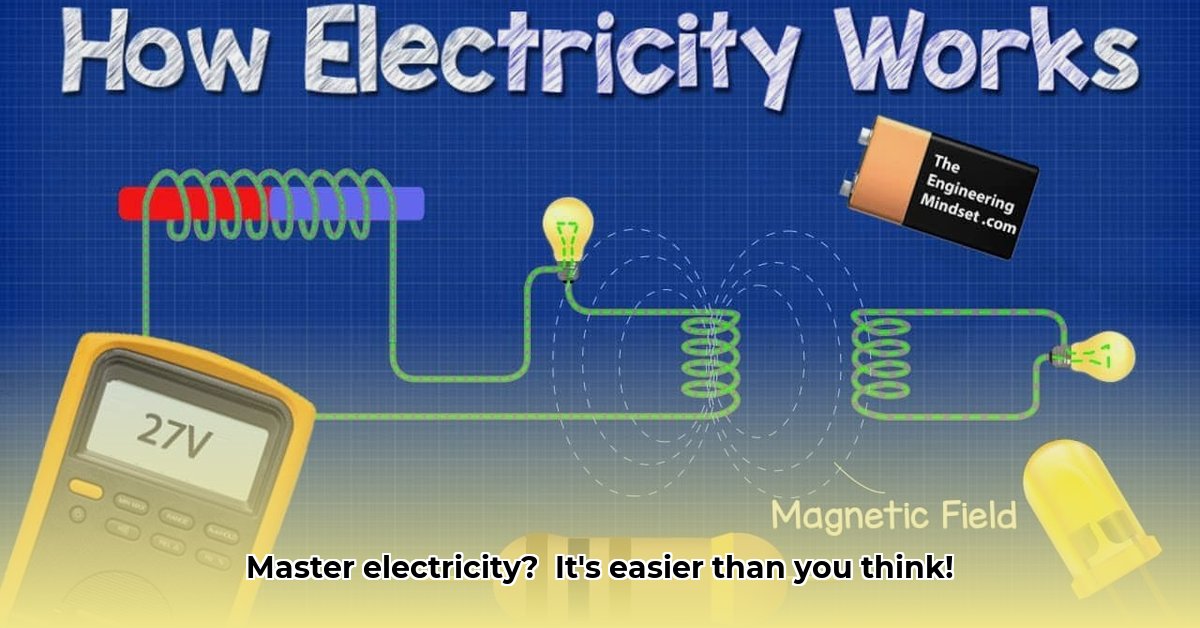
Understanding Voltage: The Electrical Push
Ever wondered how electricity makes things work? It might seem mysterious, but the fundamental principles are surprisingly simple! Let's start with voltage. Think of voltage as the electrical pressure that pushes electrons through a circuit. It's measured in volts (V). The higher the voltage, the stronger the push. A battery, for instance, provides the voltage, creating this "electrical pressure." Without voltage, there's no flow of electricity. For a deeper dive into electrical theory, check out this helpful resource: Learn more.
Imagine a water tank: the higher the water level, the greater the pressure pushing the water out of a pipe. Similarly, higher voltage means a stronger electrical "push."
Mini-Quiz: What units are used to measure voltage? (Answer: Volts)
Grasping Current: The Flow of Electricity
Current is the actual flow of electrons, the tiny charged particles responsible for powering devices. It's the amount of electricity moving through a circuit. We measure current in amperes (amps, A). Sticking with the water analogy, if voltage is the pressure, current is the amount of water flowing through the pipe.
A small current might power a tiny LED, while a much larger current is needed to run a refrigerator. The amount of current depends on both the voltage and the circuit's resistance (explained next).
Interesting Fact: A typical household circuit might carry 15 to 20 amps of current.
Resistance: The Electrical Speed Bump
Resistance is anything that impedes the flow of current. Think of it as friction in a water pipe – some pipes are smoother, allowing water to flow easily; others are rougher, creating resistance and slowing the flow. We measure resistance in ohms (Ω), represented by the Greek letter omega.
Wires generally have low resistance, allowing electricity to flow freely. A light bulb, however, has high resistance; this is intentional—it restricts the flow, converting electrical energy into light and heat.
Question: Why is resistance important in electrical circuits? (It controls the amount of current flowing through the circuit, preventing damage and allowing us to control the energy used in different applications).
Ohm's Law: The Simple Equation
Ohm's Law is a fundamental principle that connects voltage (V), current (I), and resistance (R): V = I * R. This means voltage equals current multiplied by resistance. Knowing any two values lets you calculate the third.
For example: If you have a 12-volt battery (V=12) connected to a light bulb with 6 ohms of resistance (R=6), the current is: I = V/R = 12/6 = 2 amps.
Real-World Example: Ohm's Law helps engineers design circuits, ensuring components don't overheat or fail due to excessive current.
Series vs. Parallel Circuits: Different Paths, Different Results
Electrical components can be connected in two main ways:
Series Circuit: Components are connected end-to-end; electricity follows a single path. If one component fails, the entire circuit stops working. Current is the same throughout, but voltage is divided proportionally among the components. Think of Christmas lights connected end to end, if one goes out, they all go out.
Parallel Circuit: Components are connected on separate branches; electricity has multiple paths. If one component fails, others keep working. Voltage is the same across all branches, but current splits proportionally among them. Think of your home's electrical wiring, it has many independent circuits.
AC vs. DC: The Two Types of Current
Direct Current (DC): Flows in one direction constantly, like from a battery. Many electronic devices use DC power.
Alternating Current (AC): Constantly changes direction, oscillating back and forth. This is what comes from wall outlets and is more efficient for transmission over long distances.
Expert Insight: "The choice between AC and DC depends heavily on the application," explains Dr. Emily Carter, Professor of Electrical Engineering at MIT. "DC is ideal for electronic devices, while AC excels for long-distance power transmission."
Beyond the Basics
You've now grasped fundamental electrical concepts! This foundation allows you to explore more advanced topics, such as capacitors, inductors, and more intricate circuits. Keep learning and experimenting (always safely!), the more you explore, the deeper your understanding will become.
Key Takeaways:
- Understanding voltage, current, and resistance is foundational to electrical knowledge.
- Ohm's Law is a cornerstone formula for circuit analysis.
- Series and parallel circuits represent fundamentally different ways of connecting components.
This guide serves as a springboard to a more comprehensive understanding of electrical theory. The world of electricity is vast and exciting—explore and keep learning!